
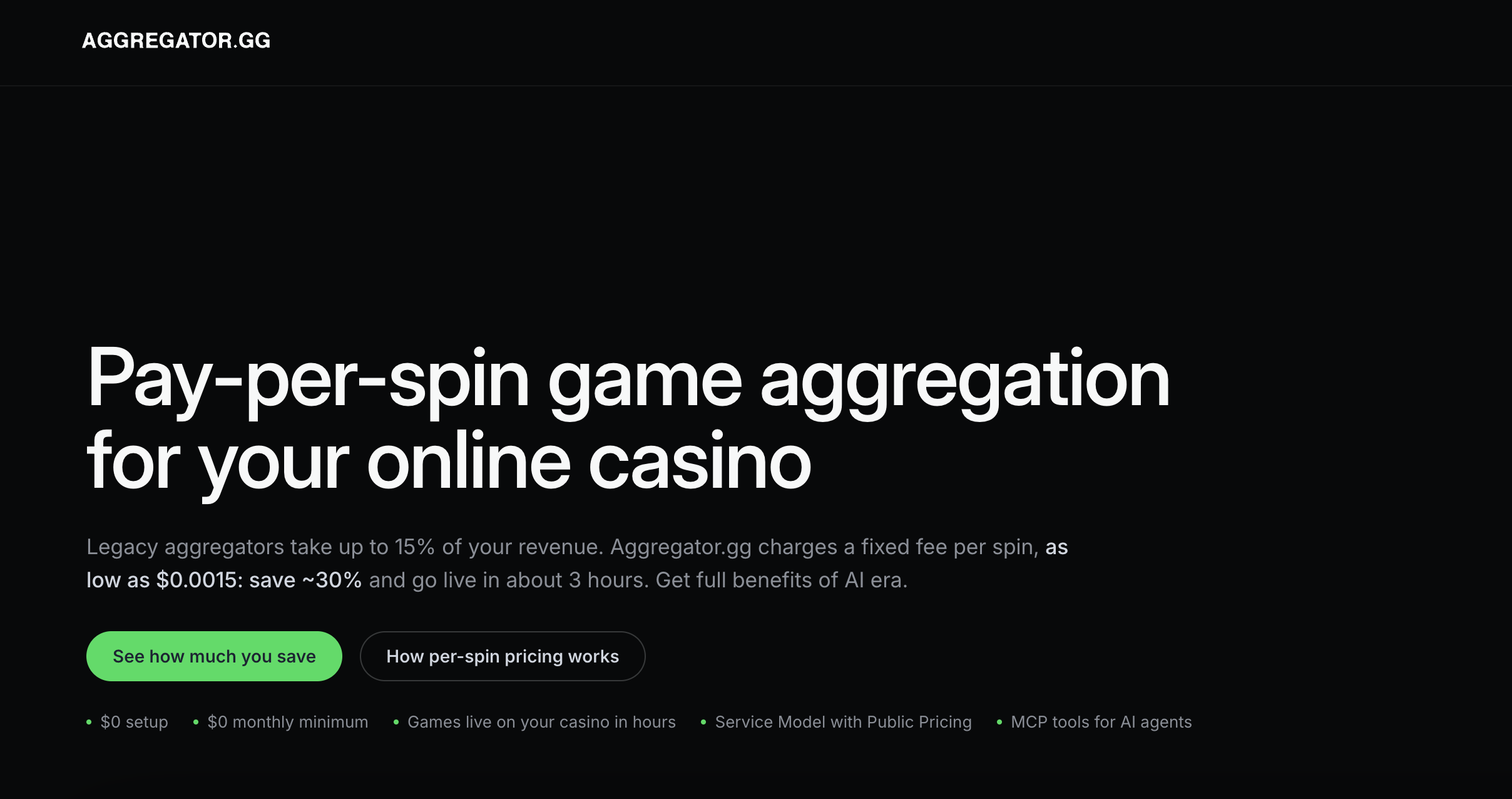
Introducing Aggregator.gg: per-spin pricing and documented AI access for casino game aggregation

27 Oct 2026
Aggregator.gg is a B2B software infrastructure company serving iGaming operators and game studios. This article looks at the thinking behind the company, its commercial model, and what a technical team can check for itself before starting an integration.
This article looks at the thinking behind the company, its commercial model, and what a technical team can check for itself before starting an integration.
Why the company was founded
The company’s published background sets out its rationale for charging by usage rather than taking a share of operator revenue. It also describes AI assistance and human approval as part of its approach to integration and operations. These are the company’s stated priorities, not a measured claim that every integration can be completed within a particular time.
The team works to four stated principles:
- The unglamorous parts are the product: signing, idempotency, replay windows and reconciliation.
- Research is ongoing: internal tools are rebuilt when something better appears.
- Agents operate, people approve: operational work is automated, judgement stays human.
- Only verified numbers are published: every figure on the company's site should have a checkable source.
A per-spin commercial model with published rates
Aggregator.gg sells prepaid spin packages rather than charging a percentage of operator revenue. As checked on 27 October 2026, its public rate card for operators buying capacity for one brand lists:
- Starter: 100,000 spins at $0.0022 per spin ($220)
- Growth: 1 million spins at $0.0019 per spin ($1,900)
- Scale: 10 million spins at $0.0017 per spin ($17,000)
- Pro: 100 million spins at $0.0015 per spin ($150,000)
- Enterprise: 500 million spins and above, on custom terms
The Starter, Growth, Scale and Pro packages list six-month validity and one brand per package. Enterprise validity and brand scope are agreed on custom terms. The company lists no setup fee and no monthly minimum. Buyers should check the current pricing page and applicable terms before purchasing.
Platforms that serve several operators agree their terms directly, with volume pooled across all the operators on the platform.
What the platform covers
The company’s published product information groups its features into four areas:
- Games: catalog access and provider integrations, subject to provider permissions, applicable market requirements and integration validation.
- Integration: an MCP server for AI agents, a guided integration wizard, demo sessions on real game builds, a go-live readiness check and a TypeScript SDK.
- Operations: web workspaces and a Telegram Mini App, usage analytics, low-balance alerts, team roles, and API-key controls.
- Billing and support: monthly reporting and company-listed support through the web app and Telegram.
What technical buyers can inspect in the public documentation
A large share of Aggregator.gg's technical material is public, so an integration team can review it before any commercial conversation. The Developer Hub includes:- HTTP API documentation and code samples
- a Node.js SDK and TypeScript tooling
- the hosted MCP server reference
- agent guidelines describing how AI tools are expected to behave
- an llms.txt file for AI-assisted reading of the documentation
- a public status page and rate-limiting guidance
The documentation can be inspected without an account. It describes an unauthenticated MCP health endpoint and gives examples of the responses to a missing API key or an unsupported HTTP method. These are documented behaviours; this article does not present them as independent live-service tests.
Hosted MCP: what AI agents can read and where access stops
Aggregator.gg documents a hosted Model Context Protocol server for authenticated catalog and integration-state reads. Its remote action tools are disabled. One qualification matters for platform accounts: the underlying Core API can create an unknown brand reference during a catalog lookup when account policy permits. Teams should use existing explicit brand references; disabled remote actions do not make every underlying lookup free of side effects.
It registers 17 tools in three groups:
- 10 remote reads: catalog games and providers, existing sessions, readiness runs and their evidence, and transactions, subject to the key's permissions.
- 5 remote actions: visible but denied on the hosted service, including creating sessions and running the readiness check.
- 2 local advisories: planning aids computed from facts the caller supplies, labelled unverified and never a go-live decision.
According to the Developer Hub, connections use stateless JSON-RPC over HTTPS POST, with a Bearer API key supplied on each request. The Worker forwards the key to Core and keeps it in request-scoped memory without persisting it. Redacted audit records do persist; this is not a guarantee about client logs or infrastructure telemetry. Read tools can return organisation data to the AI client and its model, so teams must check that destination before connecting.
The Developer Hub does not certify universal MCP-client compatibility or a hosted OAuth/consent flow. It reports protocol, discovery and action-denial checks using synthetic keys; those checks are not real-tenant, payment or end-to-end integration acceptance.
What stays with the operator's technical team
The AI layer is presented as an aid, not a replacement for the integration itself. Under the documented model, the operator remains responsible for:
- registration and API key management
- callback and wallet configuration
- running the readiness check through the cabinet or an approved backend integration
- payment
- the go-live decision
The MCP server can explain the next step and read the evidence that already exists. Where evidence is missing, the documentation treats the item as not yet verified. It also notes that a local advisory, a demo session and a verified API or wallet test are separate kinds of evidence. This matches the company's stated principle that agents operate and people approve.
Recap: Aggregator.gg's August 2026 update
The company’s 20 August 2026 update discussed hosted MCP access and highlighted a public pricing endpoint that, according to the post, had already been available since 1 June 2026.
That historical post described remote authenticated catalog access. The public pricing endpoint lets readers inspect the published rate card programmatically; Enterprise and multi-operator platform arrangements remain subject to custom terms.
The August post describes the platform at that time. For current hosted MCP scope, authentication requirements and operational limits, the Developer Hub is the reference source.
This article uses company-supplied public information. Factual review: Aggregator.gg’s AI-assisted communications desk.
Media contact: Mia | mia@aggregator.gg | https://aggregator.gg/
Sources checked on 27 October 2026:
https://aggregator.gg/about/
https://aggregator.gg/pricing/
https://hub.aggregator.gg/mcp/
https://aggregator.gg/blog/shipped-august-2026/
More from Aggregator.gg
View company profile